


Blog
How seakeeping highlights changes to extreme ship roll from wind assisted propulsion

The Vampire Squid may look scary, and indeed its name is inspired by Dracula: it gets its name from its webbed arms, which look like a vampire’s cape. But it’s quite harmless and feeds only on marine snow and detritus, not any living creature. Still, much like Dracula, it skulks around looking for snacks in the dark. For the Vampire Squid is found in extremely deep water, with most living around a depth of 2000m in absolute pitch black. Yet even in this world of complete darkness, they are not alone, and there are predators to worry about. Unlike octopus and squid, it has no ink sac – and what good would ink do in the extreme dark? Instead, it has something of the opposite.
The vampire squid can spray a bioluminescent goo all over its attacker. It’s sticky and generates an incredible brightness that can last for up to 10 minutes. This acts like a fireworks display that confuses and disorients the predator, who can’t tell which way the vampire squid makes their escape. But even more devilish is that the attacker is now totally lit up, making them vulnerable to predation by something bigger.
In this way, the problem is highlighted for all to see. Having a way that clearly shows when and where there is an issue is something we all look for in our work. This is especially true when our work involves a system complex enough that it can make us feel like we are navigating in the dark. When it comes to the world of wind assisted ship propulsion, one concern that skulks around the marine industry is how it may affect dynamic stability, such as extreme roll.
Wind assist technology needs to interact with wind to be effective. And this means there’s no escaping the increased windage area that results. Yet it isn’t always obvious how it affects the system’s dynamic stability. Yet a certain kind of seakeeping analysis applied in a systematic way can put a spotlight on what happens. In this article, we’re going to cover how a nonlinear time domain seakeeping analysis can highlight whether wind assisted propulsion increases extreme ship roll. We’re going to cover:
- Mean wind effects
- Dynamic wind and wave effects
- Rapid extreme value statistics
First, we’re going to cover the effect of mean wind on ship heel angle.
A steady wind can still create substantially dynamic effects
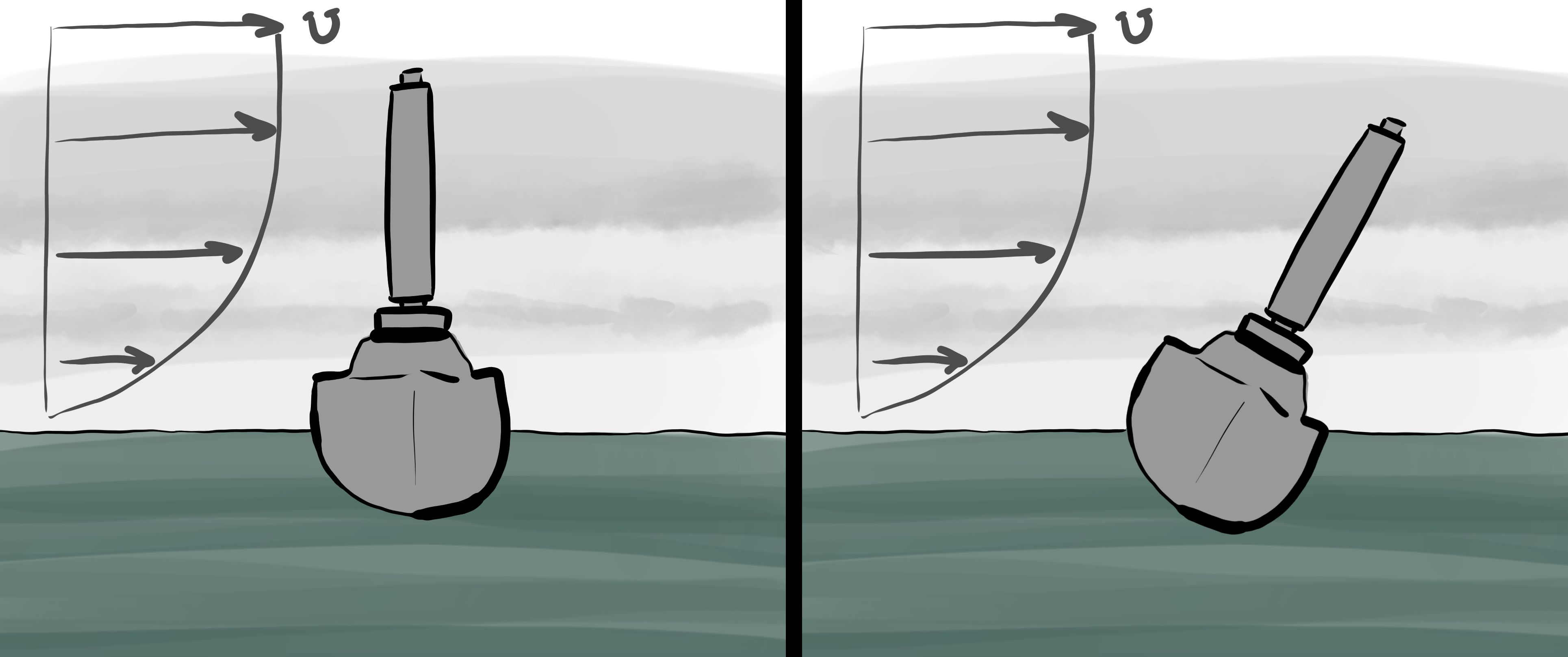
A static, unmovable system, like a building, won’t have this problem. In this case, steady wind on a fixed building would produce a steady force. But the difference is that a ship can move, and more specifically, it can roll. As roll increases, the windage area of wind assist technologies decreases. But a destabilizing roll moment from wind also depends on the distribution of windage area about the ship’s roll axis. Because the wind assist technologies tend to be so high up on ships, the change in windage area, and resulting destabilizing moments, can be quite sensitive. But windage area is not the only factor that can introduce sensitivities, even in a scenario with steady wind.
The wind has a shape that you may feel but can’t see
Even in a steady wind, speed typically varies with height. It’s essentially zero at the ground or sea surface, but grows rapidly and then gradually more upward. The idea is that even in steady wind conditions, wind velocity is much lower near the sea surface than at the highest point on any wind assist technology. Because forces are proportional to the square of wind speed, the largest destabilizing forces act on the ship at the top and near the ends of the wind assist technology. This also interacts with the changing windage area, meaning the wind forces may be sensitive and change significantly with ship roll. So how can all these steady effects create dynamic effects?
Small disturbances can lead to transient effects
In true steady conditions, the ship may settle to a steady heel angle in balance with wind. Yet this balance may be very delicate because the forces involved change significantly with small hull roll angles. The ship’s restoring force that keeps it upright depends on hull shape and therefore roll angle. These sensitivities in the resulting wind load with ship roll angle mean the ship may take a long time to settle to a steady heel, even in perfectly steady wind conditions. It is because of the nuances of these effects that even in relatively steady conditions, there may still be dynamic motion. Yet in reality, especially in survival conditions, there aren’t any truly steady metocean conditions and a flat calm water surface. This brings us to the second part on dynamic wind and wave effects.
Dynamic wind effects can produce greater extreme roll angles
This is because it adds more variability on top of steady wind effects. Real wind conditions vary in speed over time, with gusts temporarily accelerating to higher speeds for 30 seconds or more. With forces proportional to the square of wind speed and the duration of the gust involved, this can introduce a substantial dynamic effect on the ship. On the other hand, because wind forces are proportional to relative velocity, it means when the ship rolls into the wind will have extremely powerful resistance, slowing dynamic motion. This can be beneficial as it can slow roll motion. But the real uncertainty and therefore risk is what happens when the ship is rolling away from the wind, and then there is a gust on top of that.
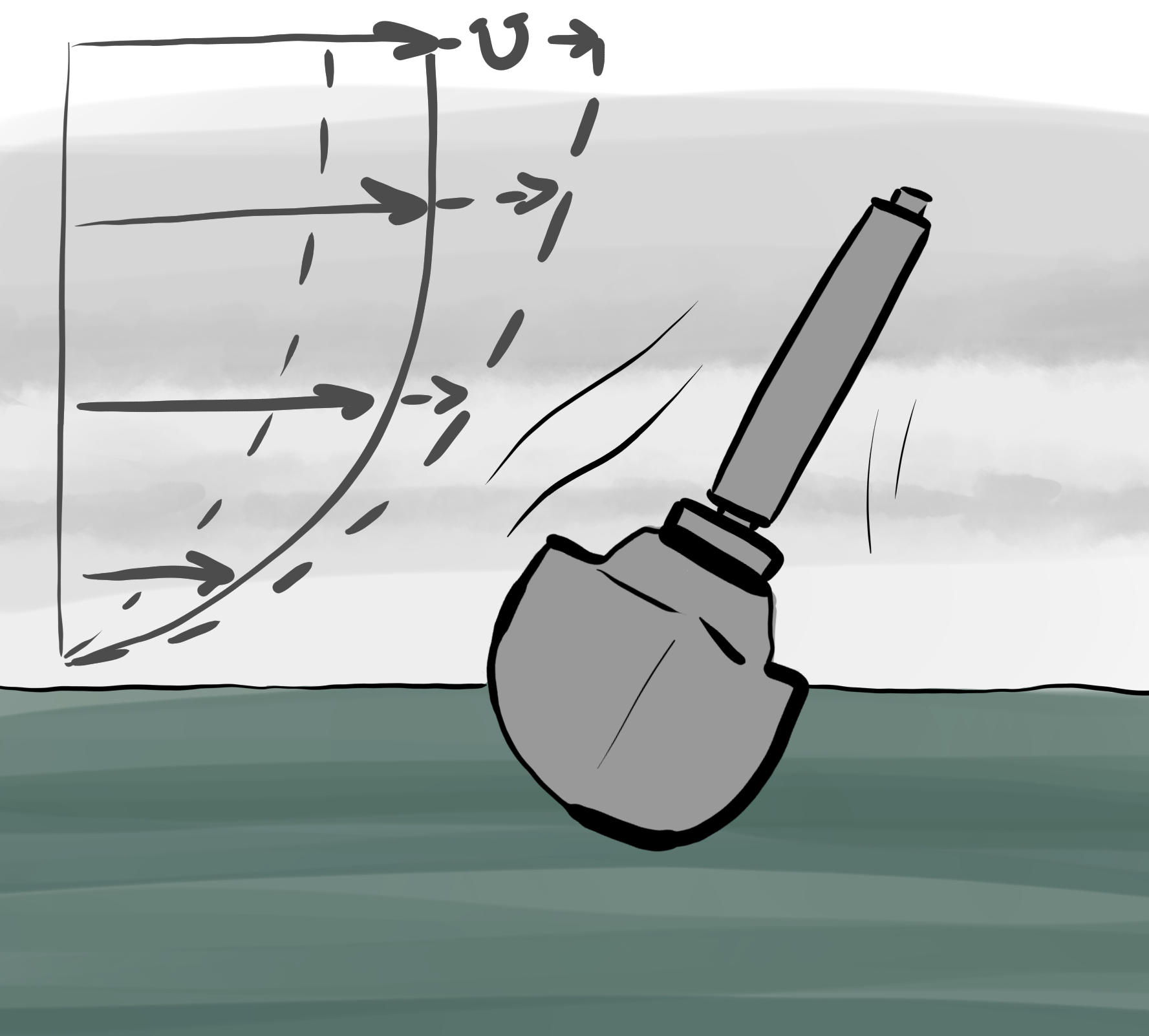
The ship’s momentum also matters, because depending on how fast it is already going, it can be harder to slow down or easier to push it to farther extremes during a gust. So the fact that the hull is dynamic and in motion then opens the door to the risk of ever greater extreme roll angles. But it’s not really the single gusting event that matters – it’s how it combines with all the other dynamic effects, and finding a practical way to explore these effects. This brings us to the third and final point, which is getting meaningful statistics in extreme roll motion.
The ship isn’t sitting upright waiting for a large gust to heel it over
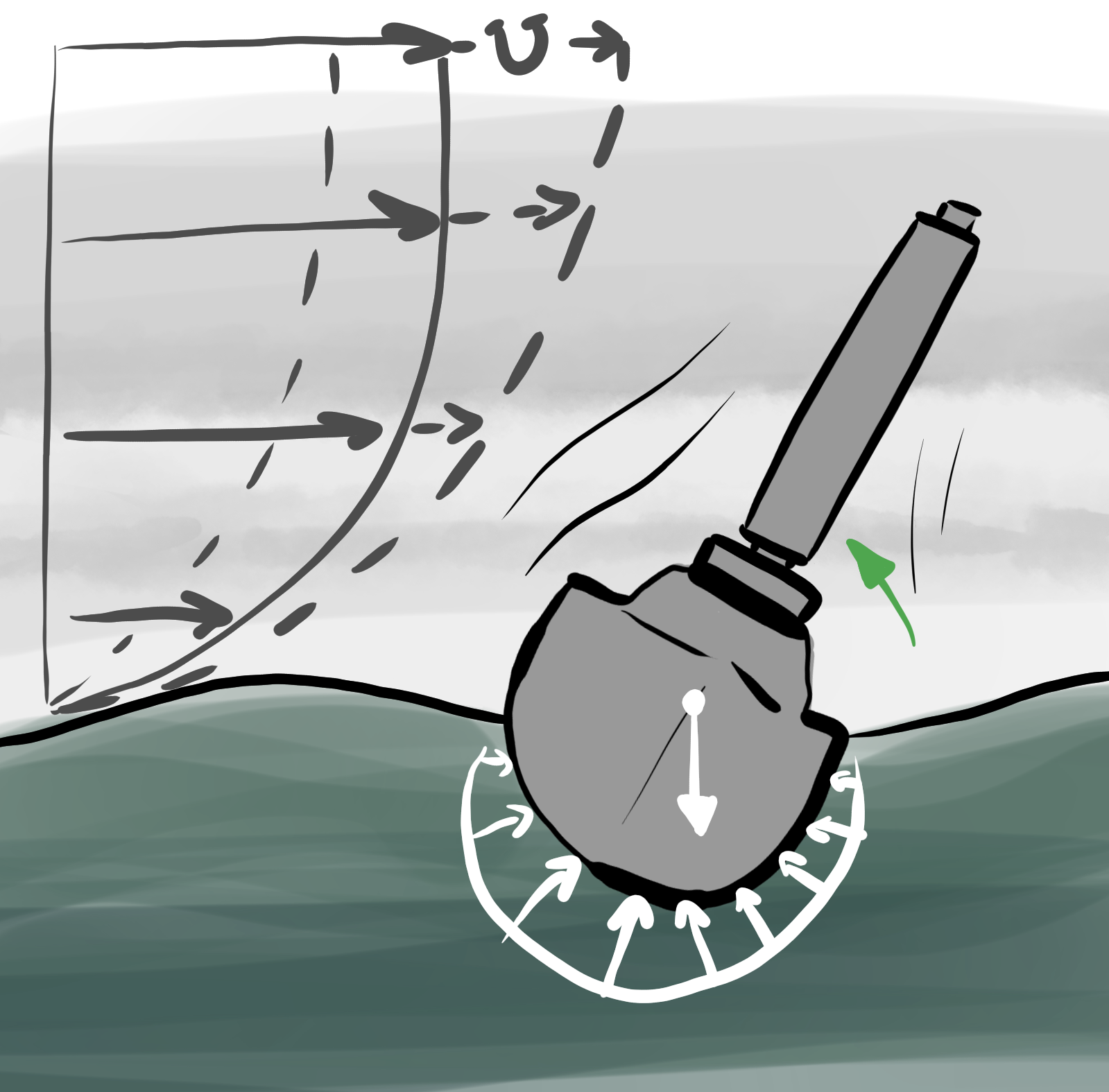
The ship has its own dynamic motion and momentum, and a key driver of that motion is ocean wave action. Yet the transient nature of these dynamics means it is unlikely the largest wave and largest wind gust will time up with the largest roll motion. What’s needed is a way to evaluate ship motion in dynamic conditions over a long period of time. If all the nuanced effects of varying restoring, wind, and wave forces can be robustly evaluated with ship roll angle, this gives confidence that the resulting characterization of the extreme ship motion values. The faster this can be done, the more rapidly this assurance can be completed to move a project forward. A sign of a thorough evaluation is that enough analysis is completed to show relatively consistent extreme values. One way to thoroughly evaluate extreme roll motion is using a time domain seakeeping analysis.
Time domain seakeeping simulation offers a practical way to address these issues in extreme conditions
It’s a practical approach because scenarios with different wind and wave conditions can be completed in a relatively short time frame. The direct simulation approach clearly shows extreme roll values, highlighting what happens during each scenario.
Often, the most likely worst case for extreme roll is a beam sea and wind condition. To build confidence in the results by showing consistent extreme values, an analyst can run several long time domain simulations to characterize the system. A time domain seakeeping analysis can also incorporate nonlinear aerodynamic effects, such as changing windage area and how it interacts with the spatial wind profile and gusting pattern. In addition, hydrodynamic effects like nonlinear Froude-Krylov and buoyancy can be included that account for the incident wave pressure field over the actual wetted hull area and variations in restoring forces as the ship heels to extreme angles.
Let’s look at an example
The EcoWindAssist ship is based on a conceptual cargo vessel with a length of 140m, a beam of 18m, and a displacement of 10,000 tonnes. A semi-rigid wind assist system was used, with sails furled, in severe conditions to evaluate extreme roll due to wind drag on masts and spars. The ship was set to maintain a course at 9 kn in a JONSWAP sea state with a significant wave height of 6 m and a 10 sec spectrum peak period. A mean wind speed of 38 m/s with a spatial profile and gusting spectrum was also used. Three time domain seakeeping realizations of 2000 seconds each were completed to evaluate the difference in extreme roll motion between an equivalent ship with and without the wind assist mast system.
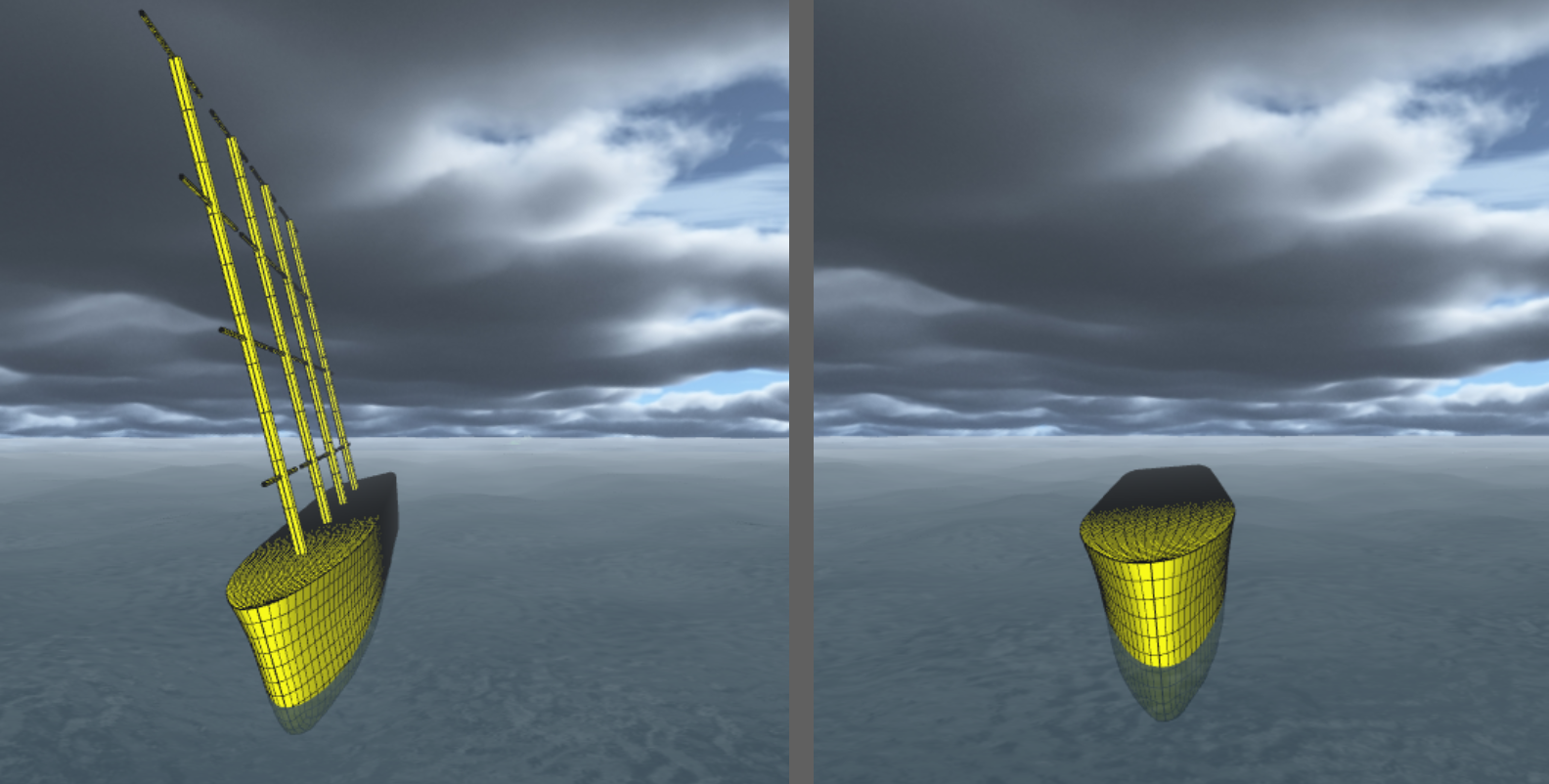
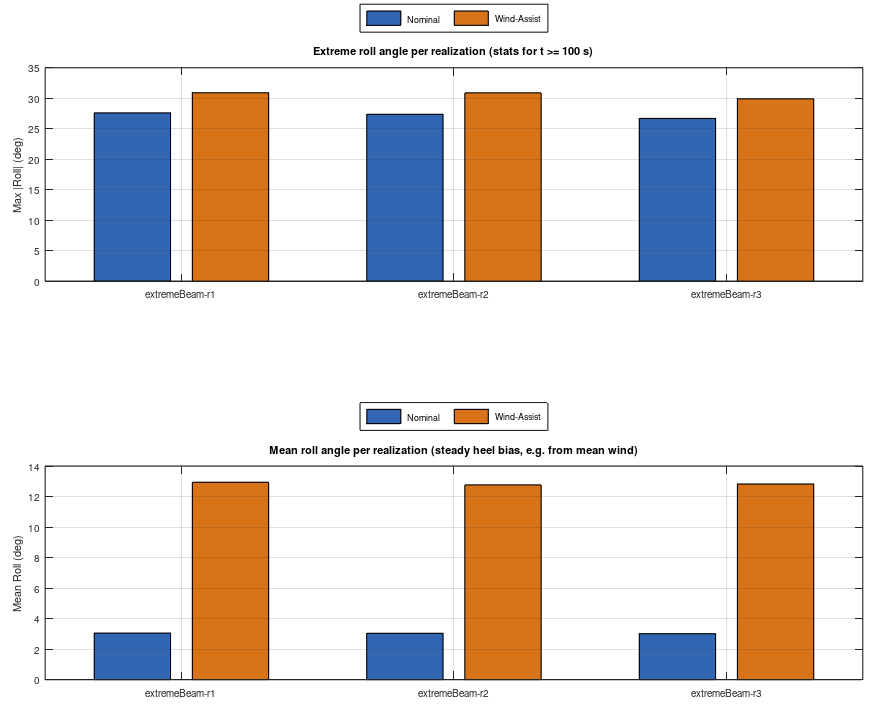
The simulation scenarios were constructed in ProteusDS and run on a typical engineering desktop computer. The total run time was about 15 hours to complete all scenarios in a parallel batch session. A typical time series comparison of the system with and without wind assisted propulsion technology. The results tend to show the extreme roll with wind assisted technology are about 12% higher, at typically 30 degrees maximum roll compared to 27 degrees.
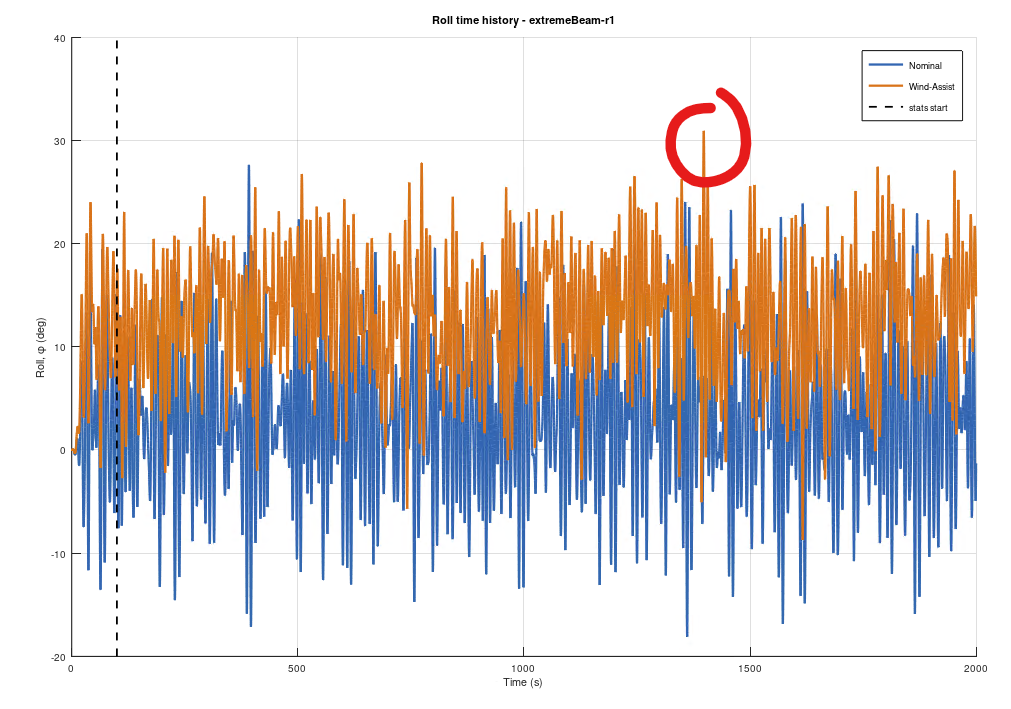
The results of mean and maximum extreme roll across all time domain simulations are summarized in the figure below. In this specific configuration, the wind assisted propulsion technology produced a mean heel angle and higher extreme roll. The time series plot also illustrates how general dynamic variation in roll is lower, showing some benefit in reduced roll from the damping effect of wind.
These results are not meant to indicate general results for ships with wind assisted propulsion technology. Each specific ship paired with a particular wind assisted propulsion system will produce a different characterization of extreme motion in different sea states, and extreme roll may be lower or higher depending on the configuration. The key point is that nonlinear time domain simulation gives a practical process that can be used to quantify extreme motion in survival conditions.
What about propulsive forces from wind assist technology?
Whatever the technology, severe weather may mean a survival condition in which wind assist technology is shut off to reduce the risk of overloading and damage. However, even with the equipment turned off, some form of the structure remains in the wind column and will induce ship motion. On the other hand, propulsive forces from different wind assist technologies could be incorporated into any time domain simulation if they can be characterized accurately. Still, incorporating propulsive forces would more likely be more relevant for evaluating ship motion in moderate conditions.
It’s time for a summary
We covered a few points on wind assist technologies in extreme conditions, and now it’s time to summarize. In extreme conditions, wind assisted propulsion interacts with the ship and environment in many ways that require careful, systematic evaluation to understand how dynamic stability changes. Wind speed often varies in both space and time: a spatial profile means speed typically increases with elevation above the sea surface, and gusting introduces dynamic bursts in velocity over time. Wind generates forces on the ship structure proportional to the square of velocity and to the structure’s drag area projected into the wind. But the drag area can also change significantly with ship roll angle. The ship’s dynamic roll motion is affected by this wind interaction, as well as by ocean waves. The nuances of the way these effects interact mean the impact on dynamic stability isn’t obvious. Yet time domain seakeeping analysis offers a systematic way to characterize extreme roll motion in survival conditions. Nonlinear wind and hydrodynamic loading opens the door to a robust way to address these aerodynamic and hydrodynamic nuances and produce a robust characterization of extreme roll and put a number to the risk. Having a robust process to put a number to the risk can show how something scary might not be a big problem after all. Much like the nefarious sounding Vampire Squid is actually completely harmless as it skulks around the murky depths, snuffling up tiny crumbs of food that fall through the water.
Next step
Many ProteusDS users work on sophisticated time domain seakeeping problems similar to the wind assisted propulsion example in this article. Yet nonlinear time domain seakeeping analysis does require more set up and detail than most ship motion prediction. The company that develops ProteusDS, DSA Ocean, has their own consulting services team that can help do this kind of analysis with ProteusDS and more. Read more about ship motion prediction capabilities on the DSA Ocean website here.
