Blog
Know your fin stabilizers
What are fin stabilizers and why are they important?
Fin stabilizers are technology that helps keep ship motion under control while in waves at sea. This kind of motion control technology can be incredibly valuable by making ships far more comfortable and safer to operate in a wider range of sea conditions. Whether a yacht used for fun or a commercial ship used for work, it means you can get far more out of your ship every year. On top of that, the more often a ship operates in areas exposed to wind and waves, the more valuable motion control technology becomes.
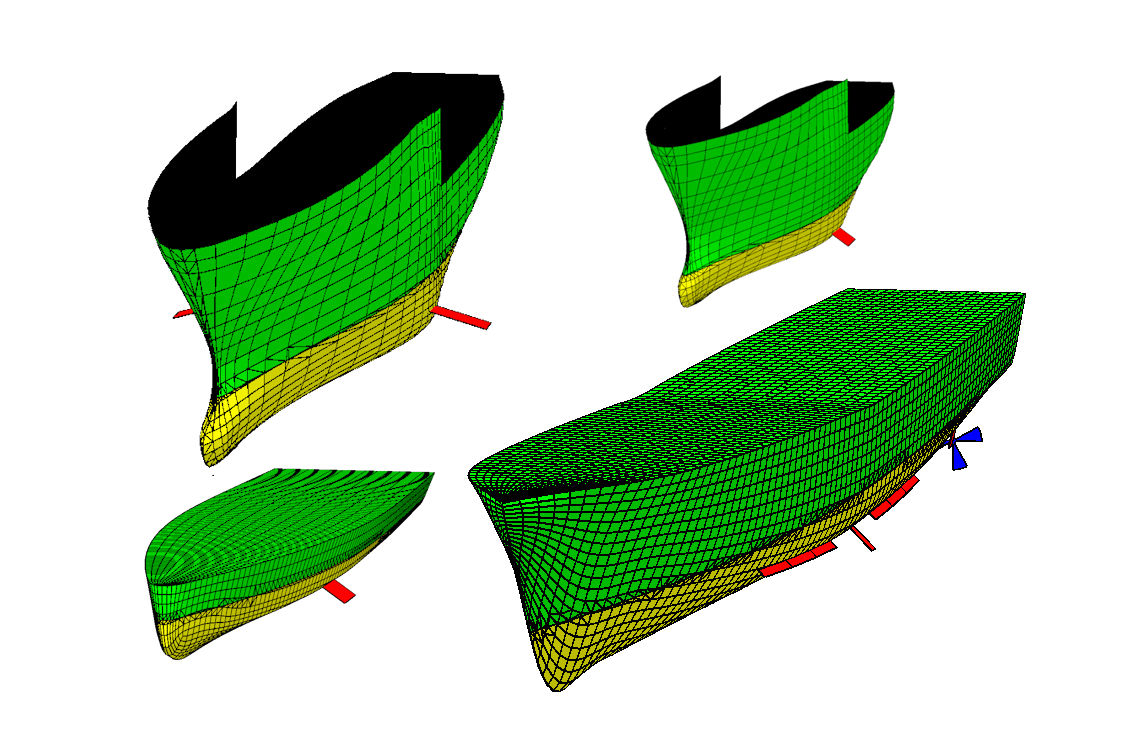
Incredibly, these systems are often quite small relative to the size of the ship, yet can be extremely effective at improving motion at sea. They tend to look like little wings that actively actuate to leverage powerful hydrodynamic effects that create corrective forces on the ship.
A myriad of technologies are available, and navigating them can be overwhelming. Yet there’s a clear trend in the classes of technologies available. Understanding the classes of technologies can help you quickly find something that works for a particular ship design.
All fin stabilizers provide motion control at forward speed
When the ship is moving, they use hydrodynamic lift to counteract rolling motion. The faster the ship speed, the more powerful the stabilization effect is. On the other hand, the slower the ship speed, the weaker the lift force is, and the less effective a forward speed fin stabilizer will be. This brings us to the first differentiation in fin technology: zero speed capability.

Some fin stabilizers provide an alternative zero speed control mode
Many fins operate completely differently at zero ship speed. They use a powerful paddling motion that, when timed correctly, helps resist ship roll. This paddling motion may require significant active actuation power, but it doesn’t require hydrodynamic lift from forward ship speed to control motion. In all cases, the forces involved scale up with the size of the fin. However, the larger the fin, the more it juts out from the side of the vessel. This brings us to the next point of differentiation in fin technology: retractable capability.
Retractable fins mean they can stow away when not in use
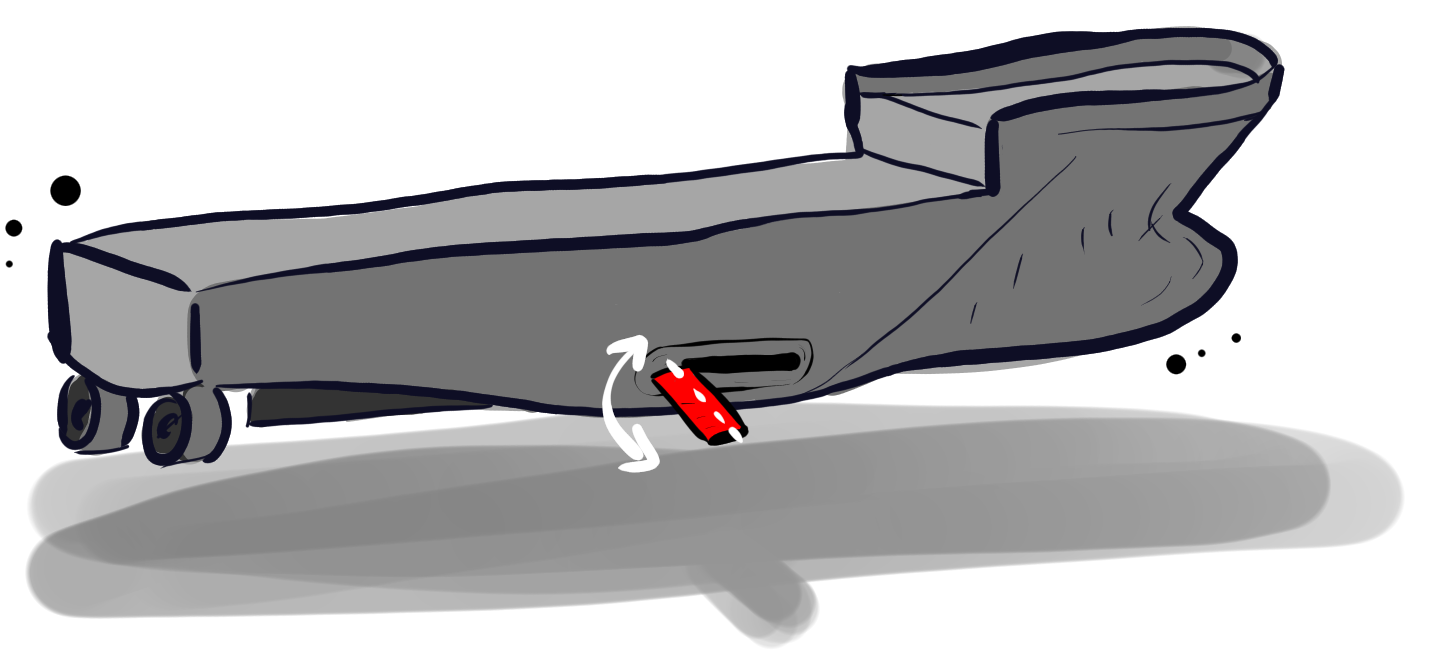
This means they have a pocket they swing or slide into the hull envelope when they are not needed. This introduces a disadvantage in more mechanical complexity and weight to the system. But it comes with a significant benefit that the fins face little to no risk of damage when stored. Many retractable fins can only control motion at forward speed. However, a few commercial products are both retractable and zero speed capable.
Here’s a list of examples
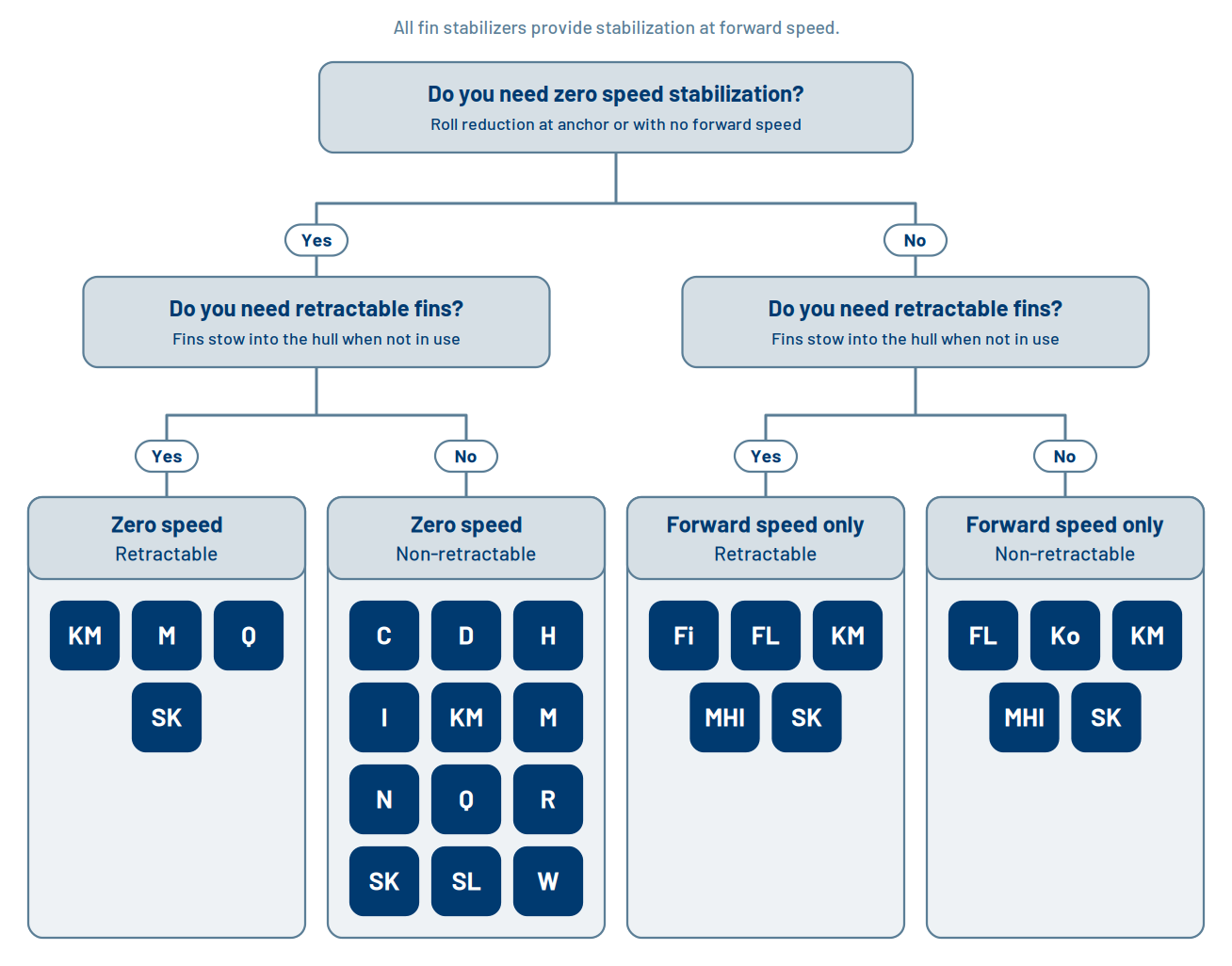
This decision tree diagram shows groupings of fin stabilizer manufacturers with the products in each of these classes. Read below the diagram for a legend for each company and links to these differentiated products.
This isn’t meant to be an exhaustive list. Products are presented in no particular order. This diagram and listing may change a few times as new information comes in about products and companies. All technologies have their own advantages and disadvantages. Still, it’s interesting to see a diversity of technologies and companies developing them.
How can I use this information in assessing ship motion prediction?
The general idea is you can filter down to products that might work based on the need for either zero speed or retractable technology. However, it makes a lot of sense to see what manufacturers and their service centers might be near you or where your clients are. It’s crucial to have good relationships with motion control companies and make sure there’s the right channels for future maintenance of this valuable equipment that will help ship owners get the most out of them.
Click to go to zero speed non-retractable
Click to go to zero speed non-retractable
Click to go to forward speed only retractable
Click to go to forward speed only non-retractable
Zero speed and retractable
Click to go back to decision tree

Kongsberg Maritime
Product: Stabilisation at rest
Note: these technologies are built with similar actuation technology to the Kongsberg Maritime Aquarius and Neptune hardware
Fin area range: up to 15m2
Models SAR 25, SAR 50, SAR 100, SAR 200, SAR 300
Product: Ice-class Stabilisation at rest
Note: these models are built with similar actuation technology to Aquarius and Neptune hardware with a significantly different ice class fin design
Fin area range: up to 13.2m2
Models SAR Ice Class 50, 100, 200, 300

SKF Marine
Product: Type Z
Fin area range: up to 21m2
Models Type Z300, Z400, Z500, Z600

MATN’S stabilizers
Product: Retractable stabilizer
Fin area range: N/A
Model Retractable stabilizer

Quantum Stabilizers
Product: DynaFoils
Note: in zero speed mode, DynaFoils use an back-and forth oaring-like motion to reduce ship roll.
Fin area range: N/A
Model DynaFoil
Zero speed and non-retractable
Click to go back to decision tree

CMC Marine
Product: Type HS
Note: for high speed, planning vessels
Fin area range: up to 3.5m2
Models HS40, HS60, HS80, HS100, HS120, HS160
Product: Type LR
Note: for semi-displacement and displacement vessels
Fin area range: up to 7.0m2
Models LR70, LR90, LR150, LR170, LR200, LR250
Quantum Stabilizers
Product: P-Type
Fin area range: up to 15m2
Models QC1000, QC2200, QC3600
Product: XT Fin
The XT fin has a mechanism for significantly expanding fin area during zero speed mode.
Fin area range: up to 15-19.5m2
Models QC1200, QC1500, QC1800, QC2200, QC3600
SKF Marine
Product: Type EFZ
Fully electric zero-speed stabilizer
Fin area range: up to 12m2
Models Type EFZ100, EFZ200, EFZ400, EFZ500
Product: Type FZ
Fin area range: up to 12.4m2
Models FZ100, FZ200, FZ300, FZ400, FZ500

Naiad Dynamics
Product: Active Fin Stabilizers
Fin area range: up to 16m2
Models 162 through 302, 320 through 525, 575 through 926, 1050 through 1400
Product: Electric Active Fin Stabilizers
Fin area range: up to 4.18m2
Models E250 through E600

Fincantieri / Fincantieri Marine Systems
Product: SFZ
Fin area range: up to 13m2
Models SFZ-0, SFZ-1, SFZ-2, SFZ-3
MATN’S stabilizers
Product: Nonretractable stabilizer
Fin area range: up to 5m2 and larger
Model Nonretractable stabilizer

Humphree
Product: Fins
Fin area range: up to 1.5m2
Model 0.6, 0.8, 1.0, 1.3, 1.5

INOV8V Group
Product: ABT-TRAC
Fin area range: up to 2m2
Model 220 through 370

RotorSwing
Product: Fin Stabilizer
Fin area range: up to 2m2
Model RS E10 Fin

DMS Holland
Product: All-In-One
Fin area range: up to 0.4m2
Model All-In-One

Product: Vector Fins
Fin area range: up to 2m2
Models Various
Forward speed only and retractable
Click to go back to decision tree
Kongsberg Maritime
Product: Aquarius
Fin area range: up to 5.78m2
Model A25, A50, A100
Product: Neptune
Fin area range: up to 22.3m2
Model N200, N300, N400, N500, N600
SKF Marine
Product: Type S
Fin area range: up to 20m2
Models Type S100, S200, S300, S400, S500, S600, S700, S800

Fouré Lagadec Marine
Product: Type R
Fin area range: up to 24m2
Models 3R, 5R, 7R, 9R, 11R, 13R, 16R, 20R
Fincantieri / Fincantieri Marine Systems
Product: SR
Fin area range: up to 22m2
Models SR-1, SR-2, SR-3, SR-4, SR-5

Product: Retractable Fin Stabilizers
Fin area range: up to 12m2
Models MR-S, MR-1, MR-2, MR-3, MR-4
Forward speed only and non-retractable
Click to go back to decision tree
Product: S-Type
Fin area range: up to 13m2
Models QC1000, QC1200, QC1500, QC1800, QC2200, QC2500, QC3000, QC3600
Kongsberg Maritime
Product: Gemini
Fin area range: up to 3.2m2
Model 10, 20, 30
Product: Modular non-retractable
Fin area range: up to 16.5m2
Model NR22, NR26, NR31, NR35, NR41
Fouré Lagadec Marine
Product: Type IS
Note: actuators (IS series) and fin area are grouped separately
Fin area range: up to 7m2
Models IS 180, IS 220, IS 280
Fincantieri / Fincantieri Marine Systems
Product: SF
Fin area range: up to 18m2
Models SF-0, SF-1, SF-2, SF-3, SF-4

Wesmar
Product: DSP5000 Wave-smart stabilizer
Fin area range: up to 2.8m2
Model FS175 through FS550

Kobelt
Product: Keypower Digital Fin Stabilizer
Fin area range: up to 2.2m2
Model KPRF4SF through KPRF24SF
Next step
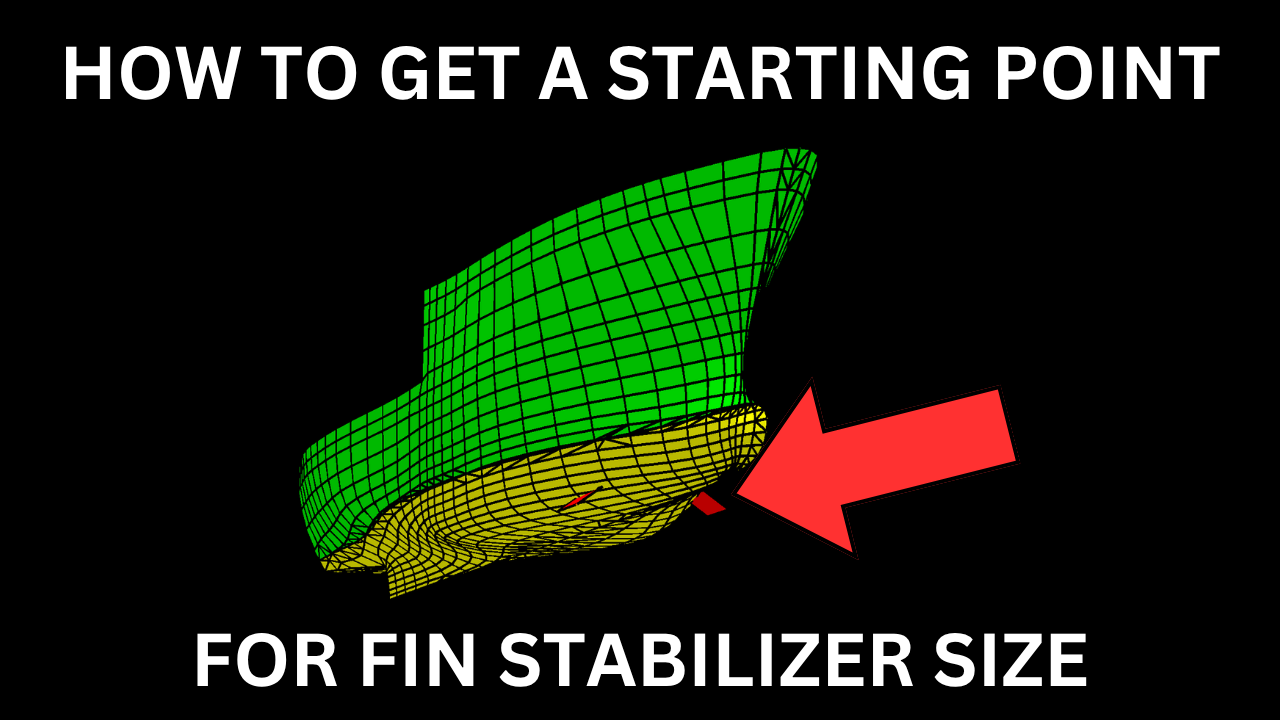
Click the image to watch a YouTube video tutorial on finding a starting point for fin area size for use in a seakeeping evaluation of fin stabilizer motion control.