


Blog
How strip theory speeds up ship motion assessment (but why ship slenderness is a serious limitation)

Manatees look chubby, but they aren’t fat at all. In fact, they have quite low body fat. The reason they look the way they do is because of their diet. They’re herbivores and eat massive amounts of sea vegetation. To handle the massive amount of processing needed, they need a huge digestive system. And a huge digestive system produces a lot of gas – hence their inflated shape. But being so pressurized isn’t really a hindrance for them, as it helps them with buoyancy, so they can cruise through the water relatively effortlessly.
Yet they’re extremely vulnerable at the same time. Their low body fat leaves them with little insulation, so they are in danger of freezing easily when the water temperature drops. There doesn’t tend to be much of a problem for them in the summertime. Yet in winter, water temperatures can drop, and this can be severe enough of a chill to put these ungainly animals at serious risk. Herds of manatees can be left scrambling for a way to find warm spots to keep alive through the cold months. Their low body fat means they are surprisingly limited.
Being aware of limitations is half the battle. But if you aren’t aware of when there can be a problem, it can leave you vulnerable and at serious risk. Similarly, there are many limitations to be aware of in the world of ship motion prediction techniques. More specifically, seakeeping analysis based on strip theory has many advantages. You can do a massive amount of processing and get many insights quickly. Yet strip theory has crucial limitations that can leave you with so much uncertainty you’re scrambling for a workaround, and it can put your design project at serious risk. In this article, we’re going to cover what strip theory is and how it can be used sensibly while keeping its fundamental limitations in mind.
What is strip theory and how does it work?
Strip theory is a simplified way to calculate the effects of ship hull and ocean wave interaction. The fundamental simplification involved is breaking down the full three dimensional wave-hull interaction problem into a series of two dimensional problems.
This theoretical analysis process is done by dividing the ship hull into several lateral sections referred to as strips. Each strip then represents the shape of the hull in a two-dimensional cross section at that location on the ship. The resulting wave-hull interaction effects are then calculated for each two dimensional strip of the hull. The resulting forces in each strip then give insight into the variation of pressure from ocean wave excitation, diffraction, and wave radiation effects.
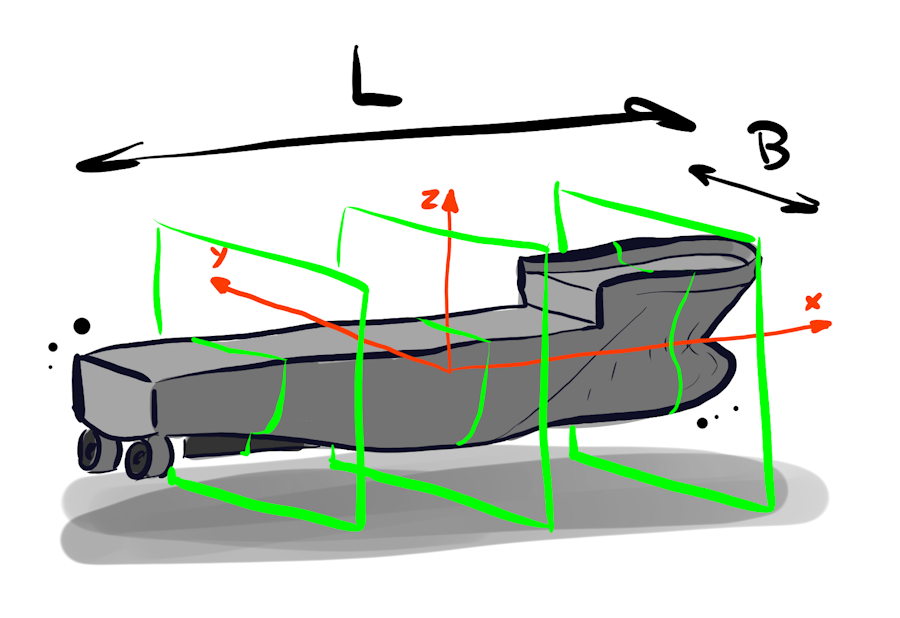
Using an algorithm that slices and dices the ship hull into strips this way provides a significant boost in computational speed
The computational speed is so much faster because the calculations involved are significantly reduced: solving a series of two dimensional hull-wave interaction effects takes far less work than solving a completely three dimensional problem that considers the entire hull all at once. This advantage then results in comprehensive wave-hull interaction hydrodynamics calculations that take only a few minutes. In comparison, an approach that solves the complete 3D wave-hull interaction might take a few hours for a comprehensive wave-hull interaction analysis. Though speed is a significant advantage, there is a serious limitation to using an approach like this.
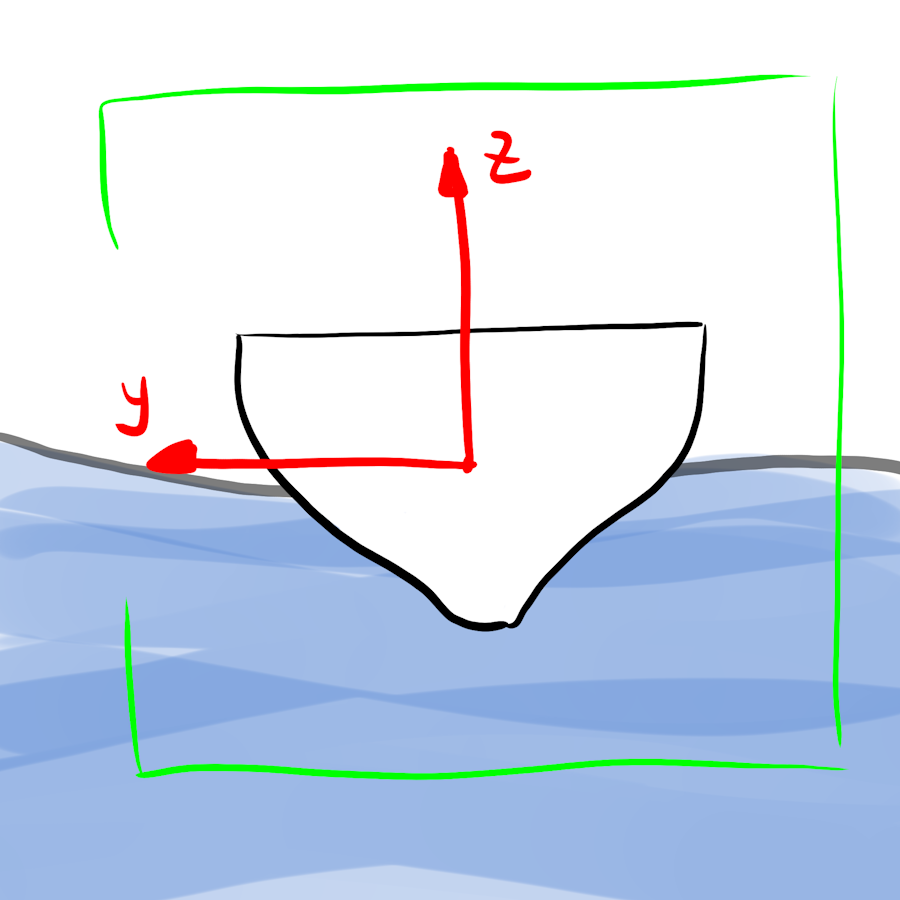
But you have to keep an eye on the slenderness, L/B, of the ship you are evaluating
One indicator of the slenderness of a ship is the ratio of the length, L, to beam, B. And this is a good rule of thumb to keep in mind when working with seakeeping tools based on strip theory. The reason this is a useful indicator is because of the way the strip theory algorithm breaks down the length of the ship into separate strips and calculates wave-hull interaction as isolated two dimensional problems. The process becomes problematic because the actual hydrodynamic interaction effects in reality become increasingly three dimensional as the hull slenderness decreases. The proportion of wave hydrodynamic flow that moves along the length of the ship becomes significant and cannot be ignored. So the assumption of solving a series of two dimensional hydrodynamics problems in isolation and blending them together is the main source of uncertainty.
NATO seakeeping analysis guidelines suggest strip theory use for L/B > 6
In other words, strip theory is considered the more reliable when used with ships that have a length to beam ratio greater than 6. The main challenge using analysis tools is that the uncertainty creeps up on you because the algorithm is still going to calculate the wave-hull interaction effects in this two dimensional way, regardless. There is no way to know how accurate the results will be. This is why the slenderness, or length to beam ratio, becomes a good indicator to consider before getting into the details of using a tool.
The main alternative to a strip theory approach is a 3D panel method
The main difference with these tools is that the algorithm solves the full 3D wave-hull interaction effect all at once, rather than breaking down the problem into several 2D sections. The consequence of this is that the wave-hull interaction calculations can take significantly more time. However, this is still highly adjustable by an analyst, and it’s possible to complete wave-hull interaction effects using panel methods in minutes, similar to strip theory tools.
Let’s look at an example
It’s rare to find examples of comparisons between ship motion predictions from both a strip theory and a 3D panel method with full scale field measurement data. Yet there is one example of this completed by Defence Research and Development Canada using full scale field trials of the HMCS Nipigon. This destroyer had a length to beam ratio of 8.5, making it suitable for strip theory analysis tools. The results of the detailed comparison of strip theory and 3D panel method results indicated that they both produced very good results when compared with the full scale field trial measurements. The strip theory method used was based on a ship motion prediction tool called Shipmo7, while the 3D panel method used was based on the ShipMo3D toolset.
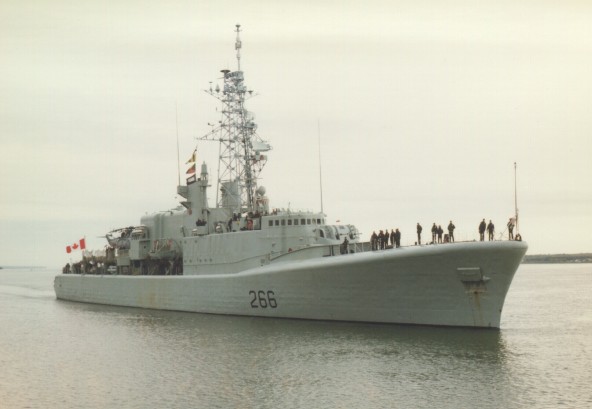
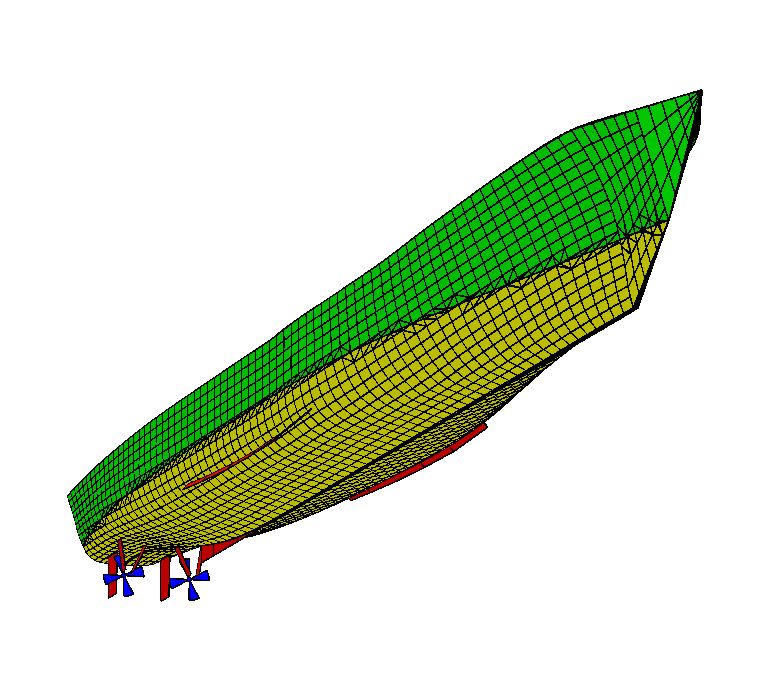
ProteusDS ShipMo3D toolset
We covered a few facets of strip theory seakeeping analysis, and now it’s time to summarize
Strip theory is an approach intended to significantly simplify the wave-hull interaction problem. It breaks down the analysis problem by dividing the length of the ship into several strips. For each strip, a two-dimensional wave-hull hydrodynamics analysis is completed. The results of each strip are then added up to give a full picture of the forces on the hull from these effects. Doing things this way is substantially faster than full three dimensional panel methods. And it’s a powerful capability that validates very well for ships with slender hulls. But flows around the hull become significantly more three dimensional on hulls with low slenderness, meaning uncertainty in strip theory tools grows. Fortunately, when you start to hit this limitation of strip theory, you have an alternative in the form of 3D panel methods to reach for. That is unlike the manatee, which, when it hits limitations of colder water, has to scramble to reach for pockets of warmth to survive.
Next step
Dive deeper into the Defence Research Development Canada technical report comparing strip theory and 3D panel method predictions of the HMCS Nipigon in the publicly available report here.
